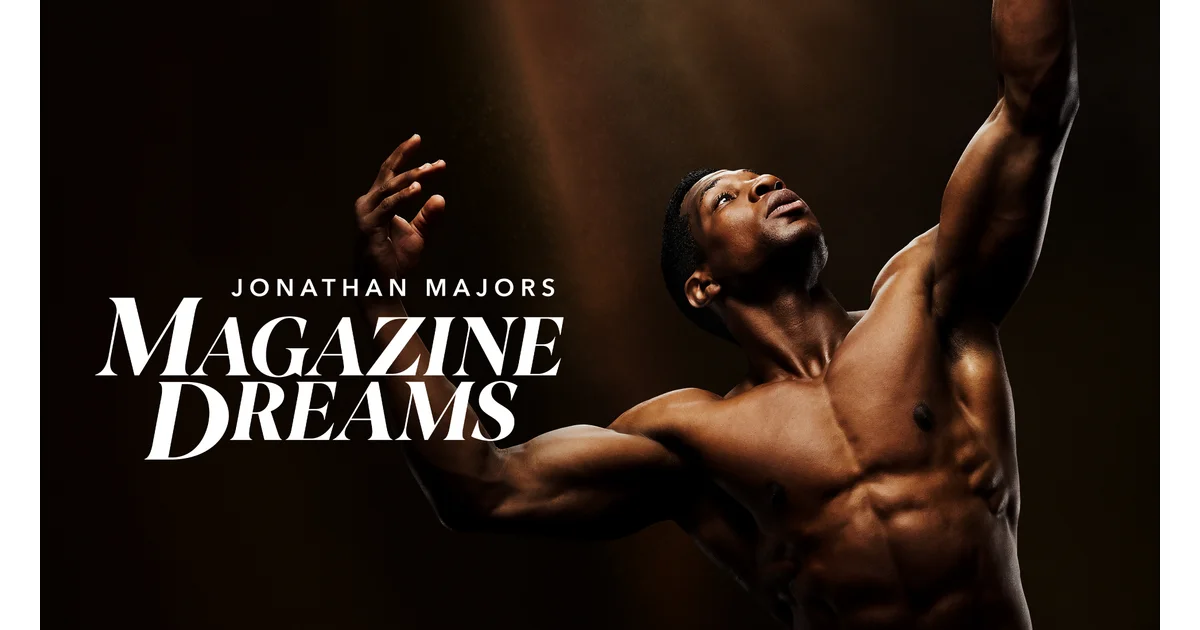
Magazine Dreams (2025) is a psychological drama starring Jonathan Majors as Killian Maddox, a lonely amateur bodybuilder whose dream of a magazine cover pushes him toward a breakdown. Writer-director Elijah Bynum premiered it at Sundance in 2023, it sat shelved for two years, and it finally reached U.S. theaters on March 21, 2025. Critics scored it 80% on Rotten Tomatoes; audiences went higher at 89%. You can stream or rent it now on Prime Video and other digital stores.
This review is updated for 2026. It covers the plot without major spoilers, a clearly marked ending breakdown, the full cast, what reviewers actually said, where the film stands after awards season, where to watch it, and how it holds up against the classics it borrows from.
What Is Magazine Dreams (2025) About?
Magazine Dreams follows Killian Maddox, an amateur bodybuilder with body dysmorphic disorder who dreams of gracing fitness magazine covers. As his obsession with physical perfection grows, his mental health unravels and his craving for human connection goes unanswered. It is a character study about ambition, isolation, and self-destruction.
Killian lives a rigid, lonely routine. He cares for his ailing grandfather, works a low-paying grocery job, and pours every spare hour into the gym chasing the body of an idol bodybuilder named Brad Vanderhorn. He even writes Vanderhorn fan letters that never get a real reply.
Underneath the muscle is a man barely holding himself together. He attends court-mandated therapy, struggles to read social cues, and lashes out when the world fails to give him the respect he believes the work has earned.
The film does not treat bodybuilding as the villain. Bynum uses it as a lens for a bigger question: what happens when a person ties their entire identity to a body that will never feel like enough. The gym is where Killian feels in control, and that illusion of control is exactly what destroys him.
Here are the key facts at a glance.
| Detail | Information |
|---|---|
| Title | Magazine Dreams (2025) |
| Director / Writer | Elijah Bynum |
| Genre | Psychological drama |
| Lead cast | Jonathan Majors, Haley Bennett, Taylour Paige |
| Premiere | Sundance Film Festival, January 2023 |
| U.S. theatrical release | March 21, 2025 |
| Distributor | Briarcliff Entertainment |
| Runtime | About 124 minutes (2h 4m) |
| MPAA rating | R |
| Rotten Tomatoes (critics) | 80% |
| Rotten Tomatoes (audience) | 89% |
| Box office | About $1.2 million |
| Where to watch | Prime Video and other digital rentals |
What Happens in Magazine Dreams? Plot Summary (No Major Spoilers)
Magazine Dreams tracks Killian Maddox over a stretch of weeks as he prepares for a regional bodybuilding contest while his life quietly falls apart. He trains, diets, and self-medicates, all while caring for his grandfather and trying to manage a temper that keeps costing him. The first half builds dread; the second half delivers on it.
The early scenes set the rhythm. Killian eats, lifts, and measures himself against photos taped to his wall. There is a strange tenderness to how he tends to his grandfather, the one relationship that asks nothing of his physique.
Then the cracks show. A judge’s dismissive feedback at a competition lands like an insult. A contractor takes his money and disappears. Each small humiliation chips at a man who has no buffer between disappointment and rage.
The most human stretch is his date with Jessie, a coworker from the grocery store. Killian rehearses, dresses up, and tries so hard to be normal that the scene becomes painful to watch. You can feel him reaching for a life outside the gym and not quite knowing how to hold it.
From there the film tightens into a slow spiral. Killian’s outbursts grow more dangerous, his grip on reality loosens, and the gap between the champion he imagines and the man he is becomes impossible to ignore. Bynum keeps the camera close, so you are trapped inside Killian’s head as the walls come in.
How Does Magazine Dreams End? (Spoilers Ahead)
Spoiler warning: this section discusses the film’s final act.
Magazine Dreams ends on a deliberately bleak and unresolved note. Killian’s pursuit of recognition pushes him into violence and a near-total breakdown, and the film refuses the tidy redemption a more conventional drama would offer. The closing scenes leave his fate ambiguous rather than triumphant.
The point of the ending is not shock for its own sake, though some critics felt it tipped that way. Bynum frames Killian as a man who confuses being seen with being loved. By the finale, the magazine cover he dreams of stands in for every connection he could not make in real life.
What stays with you is the absence of a winner. There is no trophy moment, no clean lesson. The film closes on the same loneliness it opened with, only louder, which is the most honest place a story like this could land.
What Are the Main Themes in Magazine Dreams?
The main themes in Magazine Dreams are obsession, body dysmorphia, masculinity, and loneliness. Bynum stacks these on top of each other so that Killian’s physical transformation becomes a metaphor for everything he cannot fix inside. The body grows; the man underneath stays trapped.
Body dysmorphia and the illusion of control
Killian sees a flawed body no matter how much he changes it. The gym gives him a goal he can measure when nothing else in his life makes sense. That hunger for a number, a placement, a perfect frame, is the film’s clearest window into how dysmorphia works.
Masculinity and the cost of being “hard”
Killian equates worth with size and toughness. He has no language for asking for help, so the pressure leaks out as anger. The film reads as a study of how a narrow idea of manhood can hollow a person out.
Loneliness and the need to be seen
Every relationship in the movie is a near-miss. His grandfather is fading, his idol ignores him, and his date slips away. Killian’s tragedy is that he wants connection more than fame; he just does not know how to reach it.
Fame as a substitute for love
The magazine cover is the film’s central symbol. It promises that strangers will finally know his name. Bynum suggests that chasing that kind of recognition can become a way to avoid the harder, smaller work of being known by the people right in front of you.
Who Stars in Magazine Dreams? Cast and Characters
Jonathan Majors leads as Killian Maddox, with Haley Bennett as Jessie, Taylour Paige as Pink Coat, Mike O’Hearn as idol bodybuilder Brad Vanderhorn, Harrison Page as Killian’s neighbor, and Harriet Sansom Harris as his court-appointed therapist. Majors carries nearly every frame of the film.
Jonathan Majors as Killian Maddox
This is Majors’ show, and the role asks for everything. He gained serious mass and plays Killian as a coiled mix of gentleness and menace. One moment he is shy and almost childlike; the next he is genuinely frightening, and the swing is what unsettles people.
Majors was already known for The Last Black Man in San Francisco, Lovecraft Country, Creed III, and his Marvel run as Kang the Conqueror. At Sundance, many critics argued the performance could put him in the Oscar conversation. The film’s later troubles changed that math, which I cover in the 2026 section below.
Haley Bennett as Jessie
Bennett plays Jessie, a coworker Killian asks on a date. She is the closest the film gets to warmth, and their dinner scene is one of its most quietly devastating stretches because you can feel how much Killian needs it to go right. Bennett’s other credits include The Girl on the Train and Swallow.
Taylour Paige as Pink Coat
Paige, from Zola, plays a small role billed as Pink Coat. The part is brief but pointed, underlining how out of reach ordinary connection is for Killian. Her scenes work as a quiet contrast to the noise inside his head.
Mike O’Hearn as Brad Vanderhorn
O’Hearn, a real-life bodybuilding figure, plays Brad Vanderhorn, the champion Killian idolizes and writes to. Casting an actual icon of the sport grounds the film’s fitness world and sharpens the gap between Killian’s fantasy of greatness and the indifference he gets back.
Harriet Sansom Harris and Harrison Page
Harris (Phantom Thread) plays Killian’s court-mandated counselor, the closest thing the film has to an outside voice trying to reach him. Page appears as a neighbor who offers Killian small, ordinary kindness. Both roles exist to show the help Killian cannot accept.
Magazine Dreams full cast list
| Actor | Character |
|---|---|
| Jonathan Majors | Killian Maddox |
| Haley Bennett | Jessie |
| Taylour Paige | Pink Coat |
| Mike O’Hearn | Brad Vanderhorn |
| Harrison Page | William Lattimore |
| Harriet Sansom Harris | Killian’s counselor |
| Bradley Stryker | Ken Donaghue |
The supporting cast is deliberately thin. That is a storytelling choice, not a budget one. Killian’s world is meant to feel empty, so the film keeps the orbit of characters small and the screen time skewed almost entirely toward him.
Who Directed Magazine Dreams? The Crew Behind the Film
Magazine Dreams was written and directed by Elijah Bynum, his second feature after Hot Summer Nights. Cinematographer Adam Arkapaw shot it, and Jason Hill composed the score. The film was made on a modest indie budget and an aggressive schedule, which shows in its lean, pressurized feel.
Bynum’s direction is the reason the film works and also the reason it divides people. He keeps the camera tight on Killian’s body and face, so you rarely get relief from his point of view. That choice creates real claustrophobia.
Arkapaw’s photography treats the body as landscape. The lens lingers on skin, sweat, and strain in ways that feel clinical and intimate at once. It makes Killian’s obsession physical for the viewer, not just a thing we are told about.
Hill’s score keeps a low hum of tension under even the calm scenes. There is rarely a moment where you feel safe, and that is intentional. The technical craft is consistently stronger than some of the script’s later choices.
Majors’ physical preparation deserves a line of its own. The transformation was extreme, and it reads on screen as both an achievement and a warning, mirroring the very obsession the film critiques.
Jonathan Majors’ Performance: Why It Dominates the Film
Jonathan Majors’ performance is the engine of Magazine Dreams, and it is the reason the film exists in the conversation at all. He plays Killian as a man whose body is enormous and whose inner world is tiny and terrified. The result is a portrait that critics across the spectrum called career-best, even ones who disliked the film.
The work is physical first. Majors built real mass for the role, and the camera treats that body as the character’s whole argument with the world. But the performance lives in the small choices: the flat affect, the rehearsed politeness, the way a compliment can tip into a threat without warning.
What makes it unsettling is the tenderness underneath. Majors never plays Killian as a monster. He plays him as a wounded person whose only tool for pain is force, which is far harder to watch and far harder to dismiss.
Majors has spoken about carrying the character with him after filming, framing the experience around ideas of rebirth and starting over. Whatever you make of his off-screen story, the on-screen commitment is total. For many viewers, that single performance is the entire case for pressing play.
The irony is sharp. A film about a man desperate to be seen produced a performance almost no one got to celebrate at the level it might have reached in another timeline.
Is Magazine Dreams Worth Watching? Reviews and Ratings
Magazine Dreams is worth watching mostly for Jonathan Majors’ performance. It holds 80% from critics and 89% from audiences on Rotten Tomatoes, and the critical consensus is that his fully committed work makes the film rewarding even when the story turns uneven. If you want a comfortable watch, this is not it.
The reviews split along a clear line. Almost everyone praises Majors. Opinions diverge on the script, which several critics felt piles too many crises on one character and repeats its points across a long, bleak second half.
The comparisons came fast and loud: Taxi Driver, Whiplash, Joker, even a nod to Boogie Nights. Some writers saw a powerful study of masculinity, race, and alienation. Others felt Bynum borrows the surface of those films without fully earning their depth. Both reactions are fair, and the film can hold them at once.
On Metacritic, the response landed in mixed-to-positive territory across dozens of reviews, again with the lead performance singled out as the standout. The pattern is consistent everywhere: praise for the actor, debate about the film around him.
It earned real festival credit, too. At the 2023 Sundance Film Festival, Magazine Dreams won the U.S. Dramatic Special Jury Award for Creative Vision, which is part of why distributors fought over it in the first place.
Here is my honest take. The first hour is gripping and specific, and Majors makes Killian someone you fear for and fear at the same time. The back half wore me down, partly by design and partly because the script keeps escalating instead of deepening. I respect it more than I enjoyed it, and for a film this deliberately raw, that feels like the correct response.
The pros and cons of Magazine Dreams
The strengths are easy to name. Jonathan Majors gives a career-best, physically and emotionally total performance. Adam Arkapaw’s cinematography is striking, the film’s vision is uncompromising, and its picture of fitness-world isolation feels authentic. The first hour is genuinely gripping.
The weaknesses are just as clear. The second half grows punishing, the script keeps piling fresh crises on Killian instead of deepening the ones it has, and the heavy borrowing from Taxi Driver and Whiplash can feel derivative. There is also very little relief, and the off-screen story around its star pulls focus from the work itself.
The honest summary: a remarkable performance inside a flawed film. Whether that trade is worth two hours depends entirely on how much you watch movies for acting.
Where Does Magazine Dreams Stand in 2026?
In 2026, Magazine Dreams sits as a small, well-reviewed drama that never converted its early buzz into awards. It became Oscar-eligible for the 98th Academy Awards, but the controversy around its star kept it out of the serious conversation, and the Best Actor race moved on without it. The film now lives mostly as a home-viewing title.
The awards story matters because the original plan was so different. Back in 2023, this looked like a guaranteed Best Actor campaign. By the time it actually reached theaters in 2025, the campaign was effectively dead on arrival, and the 2026 race confirmed it.
Jonathan Majors, meanwhile, has begun a real comeback. In early 2026 he started shooting his first film in about four years, an action feature produced by The Daily Wire and Bonfire Legend and directed by Kyle Rankin. He is also attached to a supernatural revenge thriller titled Merciless.
That path is itself a talking point. Returning through a politically branded studio rather than the mainstream system says a lot about how cautious major players remain. Whether audiences embrace the comeback is still an open question in 2026.
The art-versus-artist debate has not cooled either. A film about a violent, obsessive man, led by an actor with a real assault conviction, was always going to be hard to watch cleanly. Many viewers in 2026 still find that tension impossible to set aside, and that reaction is understandable.
For a new viewer today, the practical takeaway is simple. The theatrical moment has passed, the awards window has closed, and Magazine Dreams is now something you stream or rent and judge on its own difficult terms.
There is a small upside to that quieter life. Freed from the awards-season noise and the opening-weekend headlines, the film plays differently at home, where you can sit with the performance instead of the controversy. A handful of viewers in 2026 are discovering it cold, with no memory of the Sundance hype, and meeting it simply as a hard, well-acted drama. That may end up being the fairest way it ever gets seen.
How Much Did Magazine Dreams Make at the Box Office?
Magazine Dreams made about $1.2 million at the box office. It opened in roughly 800 theaters in March 2025, a limited release rather than a wide one, and never expanded into a broad commercial run. The modest total reflects its indie scale and its complicated rollout more than the quality of the work.
For context, this was never built to be a blockbuster. It is a hard-R character study with no franchise attached. Even so, the original plan involved a major awards push that would have extended its life in theaters, and that plan collapsed.
The numbers also carry the weight of the off-screen story. Distributors and audiences approached it cautiously, and a film already facing an uphill commercial battle had even less room to grow. The box office is best read as a footnote to the controversy, not a verdict on the filmmaking.
Where Can You Watch Magazine Dreams?
You can watch Magazine Dreams at home through digital rental and purchase. After its March 21, 2025 theatrical run, the film moved to video-on-demand, so streaming it is now the easiest option for U.S. viewers in 2026.
- Open a digital storefront such as Prime Video, Fandango at Home, or Apple TV.
- Search for “Magazine Dreams” and confirm the 2025 release directed by Elijah Bynum.
- Choose rent for a single viewing or buy to keep it in your library.
- Prefer physical media? A DVD edition is also available.
Availability and pricing shift over time and by region, so check the platform directly before you commit. If you are outside the United States, the listing may differ or arrive later, and a subscription home for the film may change from one year to the next.
Why Was Magazine Dreams Delayed for Two Years?
Magazine Dreams was delayed for two years because of its lead actor’s legal case, not anything in the film itself. Searchlight Pictures bought it after Sundance and planned a late-2023 awards release. After Jonathan Majors was arrested and later convicted on misdemeanor assault and harassment charges, Searchlight dropped the film and it stalled.
The timeline is worth getting right. Majors was arrested in March 2023, convicted in December 2023, and dropped by Marvel within hours of the verdict. Searchlight, like Marvel owned by Disney, returned the film’s rights to its producers in early 2024.
For most of 2024, the movie had no home. In late 2024, Briarcliff Entertainment acquired it and set the March 21, 2025 date. So the common belief that the film was “banned” is a myth: it was pulled by its original distributor, then rescued by another.
That backstory bleeds into how people watch it. A film about a violent, obsessive man became nearly impossible to separate from its star’s real-life conviction, and several critics admitted that tension openly in their reviews.
Magazine Dreams Timeline: From Sundance to 2026
The journey of Magazine Dreams is almost as dramatic as the film itself. It went from a Sundance sensation to a shelved title to a quiet 2025 release in just over two years. The chronology below shows how a likely Oscar contender became a footnote.
| Date | What happened |
|---|---|
| January 2023 | Premieres at Sundance; wins the U.S. Dramatic Special Jury Award for Creative Vision |
| Early 2023 | Searchlight Pictures acquires it for a reported seven figures, eyeing an awards run |
| March 2023 | Jonathan Majors is arrested following a domestic dispute |
| October 2023 | Searchlight pulls the film from its planned December release |
| December 2023 | Majors is convicted of misdemeanor assault and harassment; Marvel drops him the same day |
| Early 2024 | Searchlight returns the film’s rights to its producers |
| April 2024 | Majors is sentenced to a counseling program, with no jail time |
| Late 2024 | Briarcliff Entertainment acquires the film for a 2025 release |
| March 21, 2025 | Magazine Dreams finally opens in U.S. theaters |
| Early 2026 | Shut out of the awards race; Majors begins his first film in roughly four years |
Reading the timeline straight through, the tragedy is one of timing. The performance never changed. Everything around it did.
Is Magazine Dreams Based on a True Story?
No, Magazine Dreams is not based on a true story. It is an original screenplay written by Elijah Bynum, not a biopic, and Killian Maddox is a fictional character. The world of competitive bodybuilding and the experience of body dysmorphia are portrayed realistically, but the events and people in the film are invented.
The realism is the source of the confusion. Bynum researched the subculture closely, and Mike O’Hearn’s casting as a real bodybuilding figure adds authentic texture. That grounding can make the story feel like a dramatized real life, even though it is not.
It is fair to call the film “loosely inspired” by recognizable types within fitness culture. That is different from being based on one real person. If you go in expecting a documentary or a true-crime account, you will be reading the film against its actual intent.
How Does Magazine Dreams Compare to Similar Films?
Magazine Dreams sits in the same family as Taxi Driver, Whiplash, and Black Swan: intense character studies about obsession and the cost of chasing perfection. It is closest in spirit to Taxi Driver and Whiplash, but heavier and less tidy than either, with a bleaker ending and fewer cathartic payoffs.
The film wears its influences openly, which is both a strength and a complaint critics raised. If you love this corner of cinema, the references will feel like a conversation. If you do not, they can feel like borrowing.
| Film | Core obsession | Tone | What it shares with Magazine Dreams |
|---|---|---|---|
| Magazine Dreams (2025) | Bodybuilding and fame | Bleak, intense | The whole template |
| Whiplash (2014) | Drumming and greatness | Tense, propulsive | A punishing drive and an idol to impress |
| Taxi Driver (1976) | Purpose and recognition | Slow-burn dread | A lonely man drifting toward violence |
| Black Swan (2010) | Physical perfection | Psychological horror | The body as the site of breakdown |
| The Wrestler (2008) | The roar of the crowd | Melancholy, raw | A body broken in pursuit of being seen |
Use this as a quick gauge of fit. If The Wrestler or Whiplash hit you hard, Magazine Dreams will likely land. If you found those films too punishing, this one goes further in that direction, not less.
Is Magazine Dreams Too Disturbing to Watch?
Magazine Dreams is a genuinely disturbing film, and that is by design. It is rated R for strong violence and intense psychological content, and the final act in particular is bleak and hard to sit through. It is not graphically gory throughout, but the emotional weight is heavy from start to finish.
The discomfort is mostly internal. The film makes you live inside the head of a man losing his grip, so the dread builds slowly rather than arriving in jump scares. By the last stretch, that accumulated tension is the point.
Specific content to expect includes depictions of mental illness, body image obsession, self-destructive behavior, and acts of violence. Sensitive viewers should weigh that honestly before starting. None of it is played for thrills, but none of it is softened either.
If you found films like Joker or Requiem for a Dream too much, Magazine Dreams will likely cross your line as well. If you can handle unflinching drama, the difficulty is part of what makes it land.
Who Should Watch Magazine Dreams (and Who Should Skip It)?
Magazine Dreams is best for viewers who like serious, uncomfortable character studies and standout lead performances, in the vein of Taxi Driver or Whiplash. It is a poor fit for anyone wanting light entertainment, a fast plot, or a hopeful ending. The film is rated R for strong violence and disturbing content.
Watch it if you value acting above all and do not mind a story that sits in despair. Majors’ performance alone is reason enough for film fans to see it once.
Be cautious if you are sensitive to depictions of mental illness, self-harming behavior, body image struggles, or violence. The film handles these head-on and without much relief. Knowing that going in will shape whether the experience feels powerful or simply punishing.
There is also the personal calculus around the lead actor’s history. Some viewers will choose not to watch on principle, and that is a completely reasonable line to draw for yourself.
Frequently Asked Questions
Is Magazine Dreams a good movie?
Most critics and audiences say yes, with a caveat. It holds 80% from critics and 89% from audiences on Rotten Tomatoes, and Jonathan Majors’ performance is the main draw. The story turns bleak and uneven in its second half, so it suits viewers who like serious, uncomfortable dramas.
What is Magazine Dreams about?
Magazine Dreams follows Killian Maddox, an amateur bodybuilder with body dysmorphia who dreams of fame and a magazine cover. His obsession with physical perfection collides with his mental health and deep isolation. The film studies ambition, masculinity, and self-destruction through one man’s slow unraveling.
Is Magazine Dreams based on a true story?
No. Magazine Dreams is an original story written by director Elijah Bynum. It is not a biopic and does not depict real people or events. The themes of body dysmorphia and bodybuilding culture are realistic, but Killian Maddox and his journey are fictional creations.
Why was Magazine Dreams delayed for two years?
The delay followed lead actor Jonathan Majors’ 2023 arrest and conviction on misdemeanor assault and harassment charges. Original distributor Searchlight Pictures dropped the film, and it sat without a release until Briarcliff Entertainment acquired it and set a March 21, 2025 theatrical date.
Where can I watch Magazine Dreams in 2026?
Magazine Dreams is available to rent or buy on digital platforms such as Prime Video, Fandango at Home, and Apple TV, with a DVD edition also on sale. It is no longer in theaters. Prices and availability vary by region, so check the storefront before renting.
How long is Magazine Dreams and what is its rating?
Magazine Dreams runs about 124 minutes, or roughly two hours and four minutes, and it is rated R. The rating covers strong violence and disturbing themes. The pacing slows in the second half, which some viewers find draining given the film’s already dark subject matter.
Did Magazine Dreams win any awards or Oscar nominations?
It won the U.S. Dramatic Special Jury Award for Creative Vision at the 2023 Sundance Film Festival. Despite early Oscar buzz, the controversy around its star kept it out of the 2026 awards race, and it did not earn major nominations after its 2025 release.
Who plays Killian Maddox in Magazine Dreams?
Jonathan Majors plays Killian Maddox, the amateur bodybuilder at the center of Magazine Dreams. Majors, known for Creed III and Lovecraft Country, gained significant muscle for the role. His committed, unsettling performance is widely cited as the strongest reason to watch the film.
Final Verdict
Magazine Dreams is a difficult, well-acted character study that lives or dies on Jonathan Majors, and he delivers. The film is sharper in its first hour than its last, and its real-world baggage makes it hard to watch cleanly, but it leaves a mark. If you value bold, uncomfortable performances over easy entertainment, it earns a single, attentive watch.
Seen through 2026, the film reads as a what-if: the awards run that never happened, the breakout that turned into a footnote, the talent caught in a story bigger than the movie. That context does not improve or ruin the film. It just sits beside it.
Bottom line: watch Magazine Dreams for the performance, brace for the back half, and decide for yourself where you land on the art and the artist. It is not a film for everyone, and it never tries to be. What it offers is one of the most committed lead turns of its year, wrapped in a story that does not always deserve it. For the right viewer, that is more than enough.
Ready to decide for yourself? Rent or buy Magazine Dreams on Prime Video, then come back and tell us in the comments whether Majors’ performance justifies the hype.